The Lead Follow-Up Problem No One Talks About
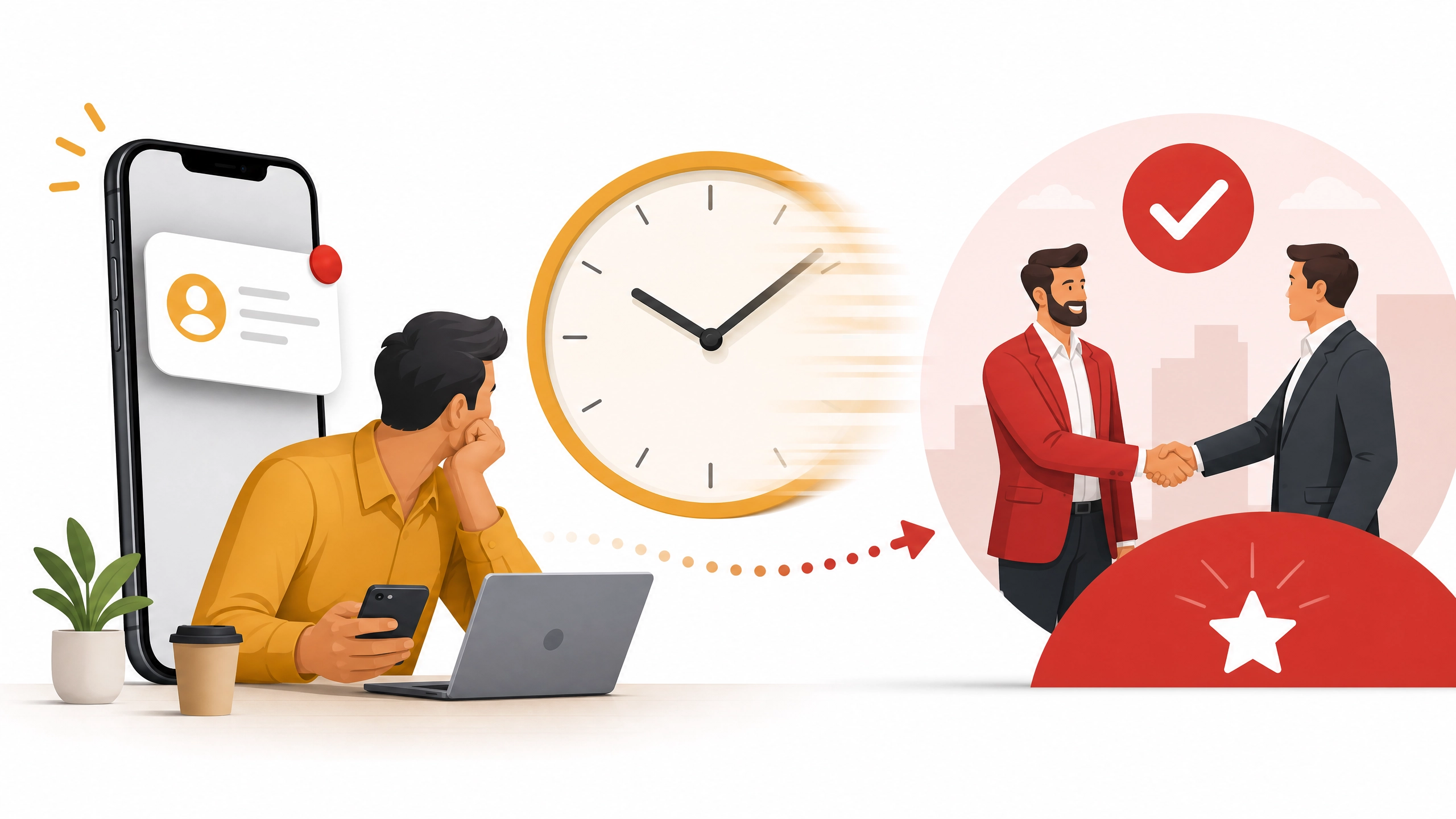
Every service business owner knows the feeling: you get a promising enquiry, you mean to follow up, and then life gets in the way. A job runs over, a supplier calls, an existing customer needs attention. By the time you remember the lead, it has been three days. You send a message anyway, but there is no reply. The prospect has moved on.
This is not a failure of intention. It is a failure of system. And it is costing UK service businesses thousands of pounds every single month.
Research from the Harvard Business Review found that companies that respond to leads within an hour are seven times more likely to qualify that lead than those that respond even an hour later. For service businesses where the average lead value is £500–£5,000, the financial impact of slow or absent follow-up is enormous.
Why Follow-Up Fails In Service Businesses
Service businesses are operationally intense. The people running them are typically also the people doing the work — cleaning, caring, building, advising. When you are on-site with a client, you cannot simultaneously be responding to new enquiries. When you are responding to enquiries, you are not on-site. The tension between delivery and growth is constant.
This creates several predictable failure patterns:
The Delayed Response
A lead comes in at 2pm on a Tuesday. You are mid-job. You see it at 6pm, intend to reply, but by then you are tired and it slips to tomorrow. By Wednesday afternoon, the lead is 24 hours old. The prospect has already received quotes from two competitors who responded within the hour. Your response, however polished, is now competing from a position of weakness.
The Forgotten Lead
Leads come in through multiple channels: email, website contact forms, social media messages, missed calls, WhatsApp. Without a centralised system, leads fall through the cracks. A Facebook message from Monday gets buried under Tuesday's notifications. A contact form submission goes to an email inbox that nobody checks daily. These leads are not lost because you did not want them — they are lost because you did not see them.
The One-Touch Attempt
Studies consistently show that most sales require five to eight touchpoints before a decision is made. Yet the majority of small businesses make one or two contact attempts and then give up. A prospect who did not respond to your first email may simply have been busy. A second message sent three days later, and a third a week after that, dramatically increases conversion rates — but most businesses never send them.
The Inconsistent Message
When follow-up is manual and ad hoc, the quality varies enormously. A follow-up sent on a good day is warm, professional, and compelling. One sent when you are stressed and busy is terse and forgettable. Inconsistency in follow-up communication undermines the professional image you have worked hard to build.
What Lead Follow-Up Automation Solves
Lead follow-up automation addresses each of these failure patterns systematically. Rather than relying on human memory and availability, an automated system ensures that every lead receives a timely, consistent, and professionally crafted response — regardless of what else is happening in the business.
The Soleraq Follow-Up Engine is designed specifically for UK service businesses. When a new lead comes in — from any channel — the system:
- Captures the lead immediately and logs it in a centralised dashboard
- Drafts a personalised response using AI, tailored to the enquiry type and your business tone
- Presents the draft for human review — a Soleraq team member checks the message before it is sent
- Sends the approved message within minutes of the original enquiry
- Schedules follow-up touchpoints if there is no response after 48 hours, 5 days, and 10 days
- Alerts your team when a lead responds, so you can take over the conversation at the right moment
The Economics Of Lead Follow-Up
To understand why follow-up automation is one of the highest-ROI investments a service business can make, consider a simple model:
| Metric | Without Automation | With Automation |
|---|---|---|
| Monthly enquiries | 40 | 40 |
| Leads responded to within 1 hour | 8 (20%) | 38 (95%) |
| Leads receiving 3+ touchpoints | 4 (10%) | 36 (90%) |
| Conversion rate | 15% | 28% |
| New customers per month | 6 | 11 |
| Average customer value (£) | £800 | £800 |
| Monthly revenue from leads | £4,800 | £8,800 |
| Additional monthly revenue | — | +£4,000 |
These figures are conservative. For businesses with higher average customer values — care homes, legal firms, specialist contractors — the impact is proportionally larger.
Industries Where Follow-Up Automation Has The Biggest Impact
Cleaning And Domestic Services
Cleaning businesses receive a high volume of price enquiries, many of which are comparison shopping. Speed of response is the primary differentiator. A cleaning company that responds within 10 minutes consistently outperforms competitors who respond in hours, even when pricing is similar. Automated follow-up sequences that include a quote, a testimonial, and a booking link convert at significantly higher rates than a single manual response.
Care And Healthcare
Families enquiring about care placements are often in a stressful situation and making urgent decisions. A prompt, empathetic response that acknowledges their situation and provides clear next steps builds trust immediately. Automated follow-up ensures that no family falls through the cracks during what is often a complex and emotionally charged decision-making process. See how Soleraq supports care sector communication management.
Trades And Construction
Tradespeople are notoriously difficult to contact and even more difficult to get quotes from. A trade business that responds quickly, follows up consistently, and makes the booking process easy has an enormous competitive advantage. Automated follow-up sequences that include a quote, availability confirmation, and a simple booking mechanism convert significantly better than the industry average.
Professional Services
Solicitors, accountants, and consultants often receive enquiries from prospects who are evaluating multiple firms. The firm that responds first with a professional, personalised message and follows up consistently is far more likely to win the instruction. Automated follow-up ensures that no prospect is left waiting and that every touchpoint reinforces the firm's professional reputation.
What Makes A Good Follow-Up Message?
Not all follow-up messages are equal. The most effective follow-up communications share several characteristics:
Personalisation
A message that references the specific enquiry — the type of service requested, the location, the timeframe — performs dramatically better than a generic template. AI-powered follow-up systems can personalise every message based on the data captured from the initial enquiry.
Clear Value Proposition
The follow-up message should remind the prospect why your business is the right choice. This might be your response time, your experience in their specific sector, a relevant case study, or a testimonial from a similar client.
A Single Clear Call To Action
Every follow-up message should ask the prospect to take one specific action: book a call, reply with their availability, click a link to get a quote. Multiple calls to action dilute the message and reduce conversion rates.
The Right Timing
The optimal follow-up sequence for most service businesses is: immediate response within 15 minutes, a second touchpoint at 48 hours if no response, a third at 5 days, and a final message at 10 days. Beyond this, the probability of conversion drops significantly and further contact risks damaging your reputation.
Human Review: The Critical Differentiator
Pure automation has a well-known weakness: it can produce messages that are technically correct but tonally wrong. A follow-up message to a family enquiring about care for an elderly parent requires a very different tone to a follow-up for a commercial cleaning contract. Getting this wrong does not just fail to convert — it actively damages your brand.
Soleraq's approach is to combine AI speed with human judgement. The AI drafts the follow-up message in seconds, but a human reviewer checks it before it is sent. This ensures that every message is not just fast, but also accurate, appropriate, and on-brand. It is the best of both worlds: the consistency and speed of automation, with the quality control of human oversight.
This is the core philosophy behind the Soleraq Follow-Up Engine — and it is what separates it from simple email automation tools.
Measuring The Impact Of Follow-Up Automation
Once you implement lead follow-up automation, you should track the following metrics to understand its impact:
- Response time — average time between lead receipt and first response
- Contact rate — percentage of leads that receive at least one response
- Engagement rate — percentage of leads that reply to your follow-up
- Conversion rate — percentage of leads that become customers
- Revenue per lead — total revenue divided by total leads received
Most businesses that implement proper follow-up automation see measurable improvements in all five metrics within the first 30 days.
Frequently Asked Questions
Will automated follow-up feel impersonal to my prospects?
Not if it is done correctly. The key is personalisation — messages that reference the specific enquiry, use the prospect's name, and are written in your business's natural tone. With Soleraq's human review layer, every automated message is checked for tone and accuracy before sending, ensuring it feels genuine rather than robotic.
What if a prospect replies between automated touchpoints?
The automation pauses immediately when a prospect replies. You are notified in real time, and the conversation continues as a human-managed exchange. The system is designed to hand off to humans at exactly the right moment.
How many follow-up messages should I send?
For most service businesses, three to four touchpoints over a ten-day period is optimal. Beyond this, the probability of conversion drops and the risk of irritating the prospect increases. Soleraq's default sequences are calibrated based on conversion data across multiple service sectors.
Can I customise the follow-up messages for different enquiry types?
Yes. Soleraq allows you to configure different follow-up sequences for different enquiry types — new customer enquiries, existing customer requests, quote requests, and general questions each have their own optimised sequence.
Does follow-up automation work for B2B as well as B2C?
Absolutely. The principles are the same, though B2B sequences typically have longer intervals between touchpoints and more emphasis on demonstrating expertise and social proof. Soleraq supports both B2B and B2C follow-up workflows.
Getting Started With Lead Follow-Up Automation
Implementing lead follow-up automation does not require a complete overhaul of your business operations. The most effective approach is to start with your highest-volume lead source — typically your website contact form or your primary phone line — and automate the follow-up for that channel first.
Once you have seen the impact on conversion rates, you can extend the automation to other channels. Within 60–90 days, most businesses have a fully automated follow-up system covering all their lead sources, with human oversight ensuring quality at every step.
If you are ready to stop losing leads to slow follow-up, book a consultation with the Soleraq team. We will audit your current follow-up process, identify where leads are being lost, and show you exactly how the Soleraq Follow-Up Engine would work for your business.
Stop Losing Leads To Slow Follow-Up
Book a free consultation and discover how Soleraq's Follow-Up Engine captures and converts more of your leads.
Book A Free Consultation